
THE PRIMARY JOURNEY


Where children discover what they're capable of
The Windsor Street Montessori Primary program is where three to six year olds step into themselves. In a carefully prepared environment designed to honor each child's pace, curiosity, and spirit, children in our Montessori Primary program in the heart of Columbia, MO do more than learn. They become confident, kind, brave members of their community.
RESEARCH-BACKED BENEFITS
The evidence is clear: Montessori primary education provides meaningful advantages that follow children throughout their lives. For Columbia families seeking an alternative to traditional preschool or kindergarten, Windsor Street Montessori offers something genuinely different: a program rooted in how children actually learn.
academic excellence
Children in Montessori primary programs build a deep, lasting academic foundation:
Early reading and math skills develop through hands-on, concrete materials instead of worksheets or pressure
Phonemic awareness, language development, and writing readiness are built simultaneously and naturally
Children move through concepts at their own developmental pace, building true understanding rather than memorized answers
Most children begin reading somewhere between ages 4 and 6, and when it happens, it feels natural and exciting
Social-Emotional Growth
Our mixed-age classroom (ages 3–6) creates rich opportunities for authentic development:
Younger children find role models in older classmates and are inspired by their work
Older children develop leadership, patience, and mentoring skills by guiding younger friends
All children practice conflict resolution, respectful communication, and collaborative problem-solving daily
Grace and Courtesy lessons give children real language for real situations
Lifelong
Skills
The Primary years are a critical window for developing the qualities that make lifelong learners:
Independence and self-direction
Focus and self-regulation
Creativity and critical thinking
Empathy and community responsibility
Confidence to try, fail, and try again
We're building the foundation for a lifetime of meaningful contribution.

THE FOOD-FORWARD* DIFFERENCE
THE FOOD-FORWARD* DIFFERENCE


*food-forward: an approach that cultivates a healthy, mindful relationship with our planet through whole-body nourishment and understanding of the interconnectedness between culture, environment, and community.
In Primary, children's relationship with food deepens, and they begin to take an active role in it.
Primary food-forward experiences include:
Taking turns setting the lunch room and snack table as part of classroom jobs
Practicing proper food handling and hygiene as real, valued responsibilities
Participating in cooking classes that integrate math, sequencing, and cultural studies
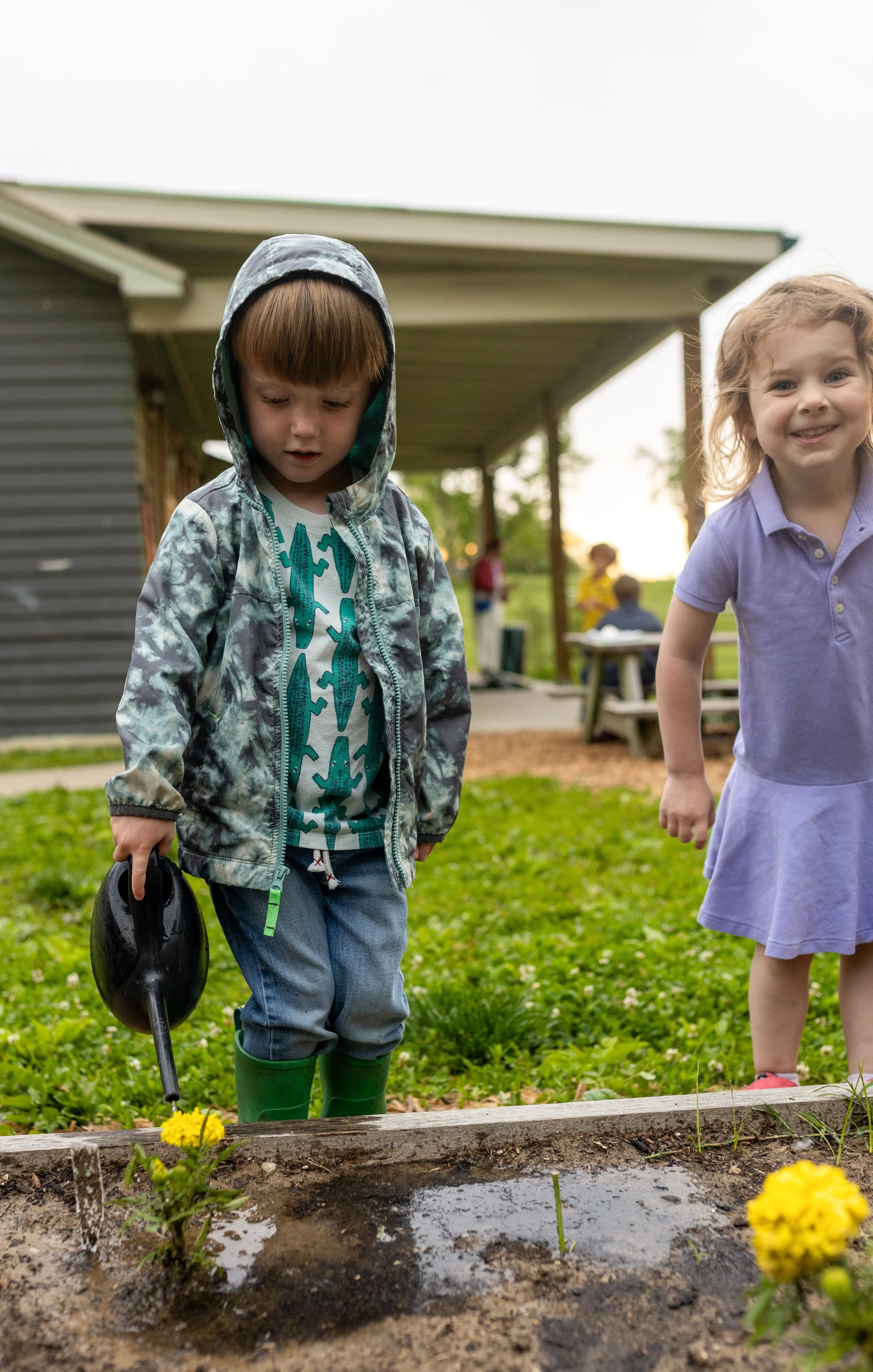
Learning where food comes from through garden work in spring, summer, and fall: planting, watering, harvesting, composting
Enjoying scratch-made, fresh, seasonal meals every day with a monthly menu shared with families
Building a healthy, lifelong relationship with food through kind, non-pressuring language
In our Primary classroom, you will never hear words like "picky eater" or "yuck." Children are invited to try one bite of each food, and that choice is always respected. Our goal is to foster a relationship with food that is functional, curious, and meaningful.

A DAY IN OUR PRIMARY CLASSROOM
Traditional education asks children to sit still and receive knowledge. We invite them to stand tall and discover it.
The heart of our Primary day is the uninterrupted work cycle: a 2 to 3 hour morning block where children move freely through the classroom, choosing their own work, receiving individual or small-group lessons from guides, and building the deep focus that will serve them for life.
If you walked into our Primary classroom during work time, you might think children were at free play. They're moving around, choosing activities, working at their own pace. This is intentional. In Montessori, we call it Freedom Within Limits: Children are free to choose their work within clear, consistent expectations for how they access it. What looks like play is, in fact, deep learning.
-
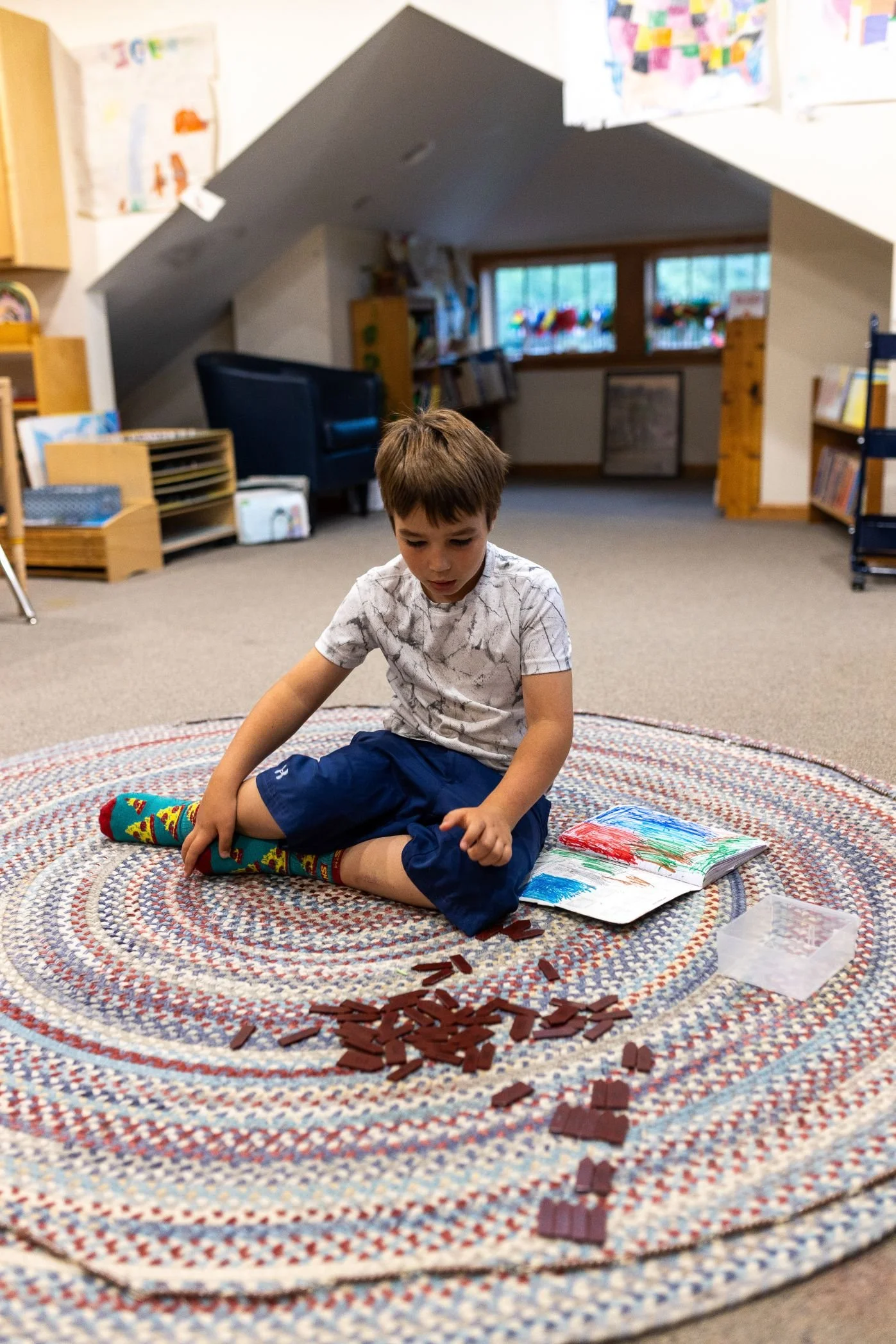
Children arrive and settle into the work cycle, choosing from Montessori materials across practical life, sensorial education, language arts, math, science, music, foreign language, and more.
-
The uninterrupted work period includes snack time, circle time, and read-aloud woven in naturally. Individual and small-group lessons from guides happen throughout.
-
Children take turns preparing the lunch space (setting tables, serving first bites and drinks) as an act of community care.
-
Children explore the outdoor classroom, which mirrors and extends the indoor environment. Seasonal activities include gardening, raking, shoveling, and building obstacle courses. Child-directed outdoor play is the norm. Guides support safety and offer invitations, not instructions.
-
A shared, community-focused meal. Children are offered one bite of each food with kind, low-pressure language. Conversation about where food came from and how it was made is a natural part of the table.
-
Collaborative projects, art, music, and continued self-directed learning fill the afternoon. Older children often step into mentoring roles during this time, reinforcing their own learning while supporting younger friends.
-
After 3:30, aftercare offers free play — outdoors whenever possible, with space for children to decompress, explore, and simply be kids.
WHAT YOUR CHILD WILL GROW INTO
By the time children leave the Primary program, families see children who:
Read with confidence and genuine excitement
Approach math with deep understanding, not memorized formulas
Choose their own work, manage their time, and stick with something that's hard
Resolve conflicts with words, patience, and real empathy
Take pride in caring for their classroom, their community, and each other
Step into Lower Elementary feeling capable, grounded, and ready
THE FULL THREE-YEAR CYCLE
Many families ask whether children need to stay in Primary for all three years. The honest answer: That third year changes everything.
In the first two years, children are learning the skills: how to use the materials, how to move through the classroom, how to work with friends. In the third year, they own those skills. Academics start to click. Leadership emerges naturally. Children become the role models younger friends look up to.
This capstone year is when children develop the focus, self-regulation, and genuine love of learning that follows them wherever they go next. They don't just know more, they know how to learn. And that matters far more in the long run.
For families considering kindergarten elsewhere: We understand. And we want you to know that children who complete the full three-year Primary cycle leave Windsor feeling grounded, confident, and more than ready for whatever comes next, whether that's our Lower Elementary program or a different setting entirely.
WINDSOR'S VALUES IN THE PRIMARY CLASSROOM
Windsor Street Montessori is built on three core values: Resilience, Worthiness, and Connection. In Primary, children don't just hear about these values, they live them every day.
Resilience shows up when a child repeats the Pink Tower over and over until it's just right. When they stick with something hard. When they hear "not yet" and try again. We don't rush them or fix it for them. We cheer them on and let them discover: I can do hard things.
Worthiness shows up when a child's voice is respected in a classroom meeting, when they're trusted to care for a plant or set the table for their friends, when they practice Grace and Courtesy and are told: your work matters, your voice matters, and you belong here.
Connection shows up at shared meals, in collaborative projects, in the five-year-old who helps a three-year-old carry a tray. The mixed-age community creates real, meaningful relationships — not just with peers, but with guides and with the land they care for together.
TUITION & Financial Aid
TUITION
Windsor Street Montessori is a year-round school. Our Primary program runs on a 10-month school year, followed by two months of summer programming.
Families can choose to pay tuition on a monthly basis or pay for the full year. Families with two children attending receive a sibling discount of 10% off tuition for the second child. Families who pay tuition in full for the year may receive a 5% discount.
School Day — 8:30 AM – 3:30 PM: $1,175/month* or $14,100/yearly
(Academic Year and Summer)Short Day — 8:30 AM – 1:00 PM: $1,020/month
Before/After Care Options Available:
Before Care — 7:30–8:30 AM: $100/month
After Care — 3:30–4:30 PM: $100/month
After Care — 4:30–5:30 PM: $100/month
*A note on monthly payments:
$14,100 divided by 12 months = $1,175
This is why during months with breaks, the monthly total remains the same! It’s part of the annual total with breaks already accounted for.
financial aid
Windsor Street Montessori offers financial aid so that we may enroll and retain students who could not otherwise afford to attend our school.
Every family receiving aid is asked to pay some portion of tuition; there are no awards for 100 percent of tuition. Financial aid is not automatically renewed. Families who receive financial aid must reapply each year.
To be eligible, applicants must complete the Windsor Street Montessori Financial Aid Application and return it with:
A copy of the most recent, complete Federal/State Income Tax Filing including all schedules
A letter to the school board stating why you wish to enroll your child and to what degree you feel able to contribute to tuition, including your intended enrollment period (1, 2, or 3 years)
PARENT TESTIMONIALS
"The thing I wish someone had told me is that the Montessori approach is not only about what your child learns, but it's about who they become. My three-year-old gets himself dressed, hangs up his coat and shoes when he walks in the door, and helps set the dinner table. He does these things because being at a Montessori school has given him the tools and confidence to do it on his own. I didn't expect him to develop such a strong sense of independence and pride in himself from an education, and I can't imagine him without it now."
Brianna, Primary Parent
FREQUENTLY ASKED QUESTIONS
-
Montessori is exceptionally well-suited for children ages 3 to 6. This is what Maria Montessori called the "sensitive period," or a window of time when children absorb language, movement, order, and social skills with remarkable ease. The Primary classroom is designed specifically for this stage, offering hands-on materials, mixed-age community, and the freedom to follow each child's natural curiosity. Rather than preparing children for school, we prepare them for learning itself.
-
In a traditional preschool, children typically follow a teacher-directed schedule, working on the same activities at the same time as a group. In a Montessori Primary classroom, children choose their own work within a carefully prepared environment, moving at their own developmental pace with guidance from a certified Montessori guide. The result is deeper understanding, stronger self-regulation, and a genuine love of learning built from the inside out, not the outside in.
-
It's the most common question we hear from prospective Primary families, and it makes complete sense. Our classroom looks different from what most of us experienced growing up. Children are moving around freely, working at their own pace, choosing their own activities. There are no worksheets coming home in a folder.
What's happening is deeper than that.
Children in our Primary classroom are working with hands-on, sensorial, concrete materials that help them genuinely understand reading, writing, and math, not just perform it. A child who traces sandpaper letters and builds words with a moveable alphabet is developing phonemic awareness, fine motor skills, and language comprehension simultaneously. A child working with golden beads is building real number sense, exploring place value through materials they can hold in their hands.
Montessori isn't about rushing children through academic benchmarks. It's about preparing them well. When children leave Primary at Windsor, they are confident, capable learners who know how to think, ask questions, and handle challenges. That readiness, more than any worksheet, is what carries them forward.

THE BRIDGE TO LOWER ELEMENTARY
As children approach the age and readiness to move into Lower Elementary, they begin visiting that classroom regularly. Because the culture and values of our school are consistent across programs, those visits feel exciting rather than overwhelming. Children get familiar with the rhythms, the space, and the guides. Then when the transition comes, it feels like a natural next step, not a leap into the unknown.
For children who started in our Toddler program, that continuity runs even deeper. Windsor grows with your child, and by the time they reach Lower Elementary, they already know who they are as learners.
Ready to see it for yourself?
Come spend time in our Primary classroom. Watch children work, choose, collaborate, and lead. There is nothing quite like seeing it in person.